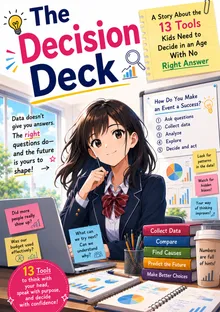
The Decision Deck
Did you compare the numbers?
A Story About the 13 Tools Kids Need to Decide in an Age With No Right Answer
View on AmazonMinami Endo used to ask "did you check that?" This year, she’s learning to ask something new: "did you compare the numbers?"
A year after cracking rumors wide open in her elementary school’s Newspaper Club, Minami has started middle school — and joined the Events Committee, where the problem usually isn’t whether something’s true. It’s what to actually do, when there’s no way to know for sure.
Buy the extra tent, or don’t? Order enough snacks for a crowd nobody can count in advance? Trust an "average" satisfaction score, or dig into what it’s actually hiding? Every school event brings a new decision with no guaranteed right answer — and Nishino-sensei, the committee’s new advisor, has exactly one question for all of them: Did you compare the numbers?
Story by story, Minami and her steady, number-loving friend Yamato pick up thirteen real decision-making tools — the same kind used in business, simplified down to their essentials — and use them to size up options, weigh what’s uncertain, and make a call they can actually stand behind.
In a world where an AI-generated answer is always one search away, the harder — and more valuable — skill isn’t finding information. It’s deciding what to do with it.
What's Inside
A Prologue plus seventeen self-contained "decision" chapters, each built around one practical thinking tool your child can actually use: The Average Trap, The Fork-in-the-Road Tree, The Three What-Ifs, The Reverse-Engineer Plan, and nine more — building, chapter by chapter, into a full Decision Deck.
- A story, not a workbook. Every tool is learned inside a real decision, not a lesson — no drills, no worksheets to dread.
- A Decision Deck card at the end of every chapter, collecting the tool into one clear, memorable rule.
- "If You Were on the Committee?" — a short, open-ended thinking prompt after every chapter, perfect for a bedtime conversation.
- "A Note for Grown-Ups" in every chapter — real, ready-to-use phrases for bringing these same tools into everyday family decisions, without ever feeling like a lecture.
- A complete, standalone story. One school year, one Events Committee, one satisfying ending — no cliffhanger, no series commitment required.
Who It's For
Perfect for kids ages 10–14 who like a grounded, character-driven school story, and for parents who want their child to build real confidence deciding with incomplete information — the kind of everyday judgment call no test ever really prepares you for.
Whether you read it in one sitting or one chapter a night, The Decision Deck turns "did you compare that?" into a question your whole family starts asking — about allowances, about plans, and about every decision that doesn’t come with a guaranteed right answer. A companion to The Hibari Gazette, but a complete story on its own — no previous reading required.
Table of Contents
Prologue
- "Did You Check That?" — The Events Committee Begins
Part One: Doubt the Basics
- 1. Same Average, Totally Different Story
- 2. A Good Guess Beats a Wild Guess
- 3. Is That "Always" Really Always?
- 4. Nothing's Ever a Sure Thing
Part Two: Compare and Apply
- 5. What's Actually Moving the Needle?
- 6. Put It in Order, and Everyone Gets It
- 7. Buy It? Or Don't?
- 8. Turning "Probably" Into a Number
- 9. Tap the Bridge Before You Cross It
- 10. Fewer, Normal, or More?
- 11. Start From the Goal, Work Backward
- 12. Sometimes, Not Deciding Yet Is the Decision
- 13. When Everything's Going Right, Go Looking for Trouble
Part Three: Question and Grow
- 14. The Thing Nobody Told Her to Notice
- 15. What Happens When You Ask AI?
- 16. Planning for the Unplanned
- 17. The Decision Deck, Handed Down