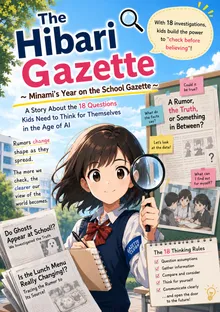
The Hibari Gazette
Did you check that?
A Story About the 18 Questions Kids Need to Think for Themselves in the Age of AI
View on AmazonTwelve-year-old Minami Endo has a habit of believing things a little too fast.
She joins her school’s Newspaper Club convinced her first story is "DEFINITELY a scoop" — and gets stopped cold by one question from her advisor: Did you check that?
That single question turns into a whole year of learning to think for herself. Story by story, chasing down rumors, mysteries, and the occasional broken vase, Minami and her steady, detail-obsessed clubmate Yamato pick up eighteen real thinking tools — used by real reporters — and use them to sort fact from feeling, trace a rumor to its source, and figure out what’s actually true before deciding what to believe.
In a world where an AI-generated answer is always one search away, the harder — and more valuable — skill is knowing how to check it yourself.
What's Inside
Eighteen self-contained mystery-of-the-week chapters (plus a Prologue), each built around one thinking tool your child can actually use: The Own-Eyes Rule, The Both-Sides Notebook, The Five-Whys Shovel, The Sunk-Cost Swamp, and fourteen more — building, chapter by chapter, into a full toolkit for thinking clearly.
- A story, not a workbook. Every tool is learned inside a real mystery, not a lesson — no drills, no worksheets to dread.
- A "Field Notes" card at the end of every chapter, collecting the tool into one clear, memorable rule.
- "If You Were the Reporter?" — a short, open-ended thinking prompt after every chapter, perfect for a bedtime conversation.
- "A Note for Grown-Ups" in every chapter — real, ready-to-use phrases for bringing these same tools into everyday family life, without ever feeling like a lecture.
- A complete, standalone story. One school year, one Newspaper Club, one satisfying ending — no cliffhanger, no series commitment required.
Who It's For
Perfect for kids ages 9–12 who like a good mystery, and for parents who want their child to build real, lasting critical-thinking skills — the kind that matter now more than ever, in a world full of rumors, social media, and instant AI-generated answers.
Whether you read it in one sitting or one chapter a night, The Hibari Gazette turns "did you check that?" into a question your whole family starts asking — about the news, about gossip, and about every "everyone says so" that comes their way.
Table of Contents
Prologue
- "This Is Definitely a Scoop!"
Part One: Doubt One Thing
- 1. How Much of a Rumor Can You Trust?
- 2. Is That a Fact—Or Just a Feeling?
- 3. Turning "Just Because" Into "Because…"
- 4. How Many People Is "Everyone," Really?
- 5. Who Actually Benefits From This?
Part Two: Compare Multiple Things
- 6. The No-Blind-Spots Glasses
- 7. What Do You Do When Two Stories Don't Match?
- 8. Collecting Both the Yeses and the Nos
- 9. Coincidence—Or Actually the Cause?
- 10. Pick Your Ruler Before You Pick a Winner
- 11. Only One Story Gets the Front Page
- 12. Don't Publish Just Because You Already Spent the Time
- 13. Building the Bones of a Story
Part Three: Ask Your Own Questions
- 14. The "Something’s Off" Nobody Else Has Noticed Yet
- 15. Connecting the Dots Between a Bunch of Small Weird Things
- 16. How Do You Actually Test a Hunch?
- 17. On Purpose, Go Talk to the Person Who Disagrees With You
- 18. The Last Big Story Before Graduation—And the Handoff